How Do I Start a Business In Luxembourg A Practical Guide
Starting a business is really about three things: making sure your idea is a good one, setting up all the legal and financial stuff properly, and then actually launching and finding your first customers. It's a journey, one that takes you from a spark of an idea to actual money in the bank, and it needs a bit of creativity mixed with a lot of solid planning.
Your Blueprint for a Luxembourg Business Launch
So, you’re ready to dive in and start a business in Luxembourg? It’s an exciting prospect, and with the right roadmap, it’s not nearly as intimidating as it might look. Think of this guide as that roadmap—a clear, high-level look at the whole process. We'll break down the essential phases, from polishing your initial concept right through to sending that very first invoice.
This isn't some stuffy legal text. It’s a practical guide to help you put the fundamental building blocks in place for a successful business in the Grand Duchy. We’ll cover the key milestones you need to hit, like:
- Idea Validation: How do you know if your brilliant idea actually has legs?
- Legal Structure: Deciding on the right setup, whether it’s being a sole trader or setting up an SARL-S.
- Financial Foundations: Getting to grips with pricing, simple bookkeeping, and managing your cash flow.
The Entrepreneurial Journey in Three Steps
The path from a thought in your head to a running business can be broken down into a pretty simple progression. This visual lays it out perfectly.
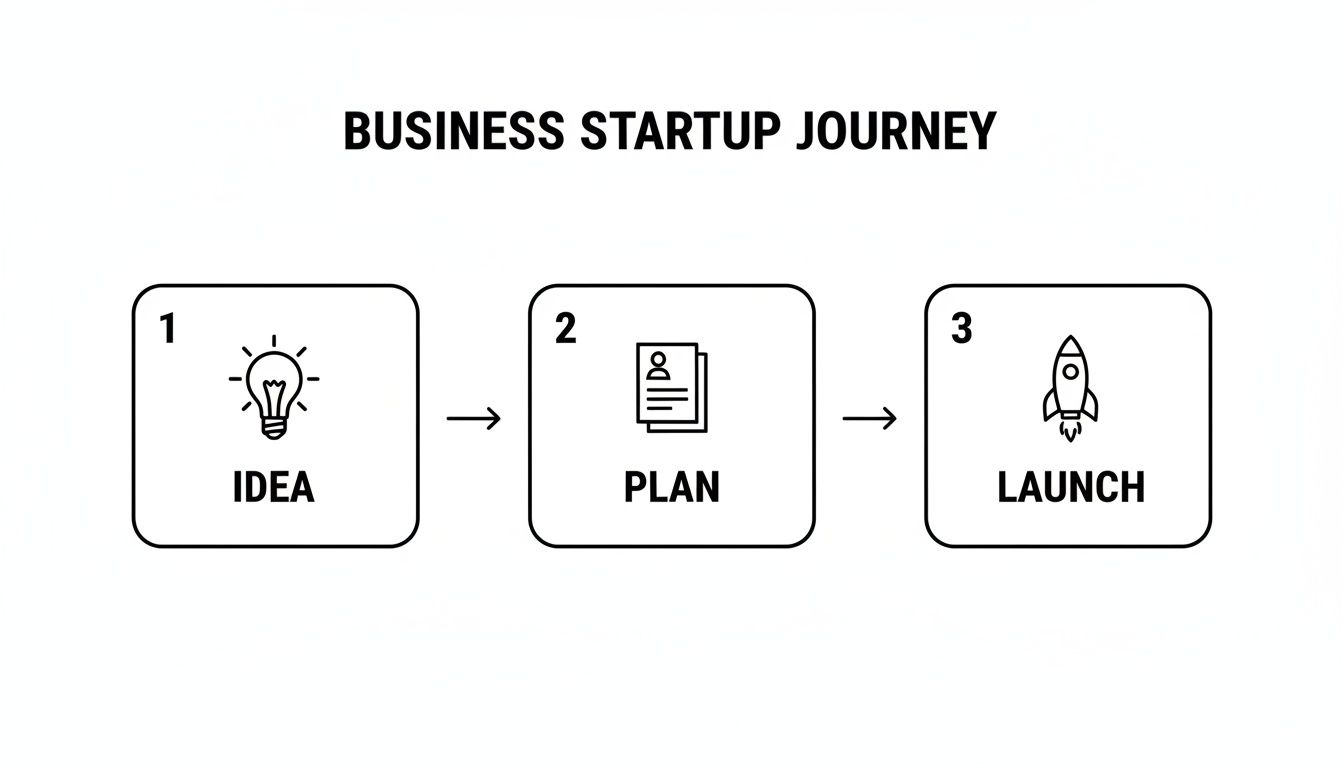
It’s a clear reminder that a strong launch is built on solid planning, and that planning all starts with an idea that you've properly tested. Each step feeds into the next, building the momentum you need to get off the ground.
To give you a bird's-eye view, here's a quick summary of the path ahead.
Luxembourg Business Launch Roadmap
| Phase | Key Action | Primary Goal |
|---|---|---|
| 1. Idea & Validation | Research the market and talk to potential customers. | Confirm there's a real need for your product or service. |
| 2. Planning & Setup | Choose a business structure, write a plan, and register. | Build the legal and financial foundation of your business. |
| 3. Launch & Growth | Find your first clients and set up your invoicing system. | Start generating revenue and establish your market presence. |
This roadmap simplifies the journey into manageable stages, making it easier to focus on what matters right now.
A Thriving Environment for New Ventures
Honestly, there has never been a better time to take the leap. The entrepreneurial scene in Luxembourg is booming. Recent figures show that entrepreneurial intentions have hit a record high of 20.8% of adults. Even better, the fear of failure has dropped to just 41.4%—the lowest it’s ever been here.
A massive 61% of people agree that starting a business in Luxembourg is straightforward, which is way above the European average. You can dig into more of these stats about Luxembourg's entrepreneurial spirit on gemconsortium.org. This supportive atmosphere, paired with clear administrative steps, makes it a great place to build something new.
At its heart, starting any business is about solving someone's problem. Your first job isn't to design a beautiful logo or a fancy website. It's to prove that people will actually pay for the solution you're offering.
In the next sections, we'll dive deep into each of these areas. I’ll give you actionable steps, real-world examples, and the templates you need to feel confident moving forward. Let's get started.
Validating Your Idea and Building a Business Model
That brilliant idea you have? It feels like a lightning strike, I know. It's full of energy and potential. But an idea on its own isn't a business—not yet. The real work starts when you ground that electricity in a solid business model, the framework that proves your idea can actually make money and keep the lights on. This is the moment you shift from daydreaming to doing.

Forget about writing a hundred-page document that will just gather dust. This process is about answering a few fundamental questions with real-world evidence. Who are you actually serving? What specific, nagging problem are you solving for them? And here’s the big one: are they willing to open their wallets for your solution? Getting these answers right from the start is the single most important thing you can do.
From Concept to Customer Validation
Before you pour your life savings or countless hours into your venture, you need proof. You need to know that people genuinely want what you’re planning to offer. That’s what idea validation is all about. It’s the critical shift from "I think this is a great idea" to "I know people will pay for this." The good news? You don't need a huge budget for this—you just need to be clever.
Start by getting laser-focused on your ideal customer. "Small businesses" is far too vague. You need to be able to picture them. For instance, instead of a broad target, try: "Luxembourg-based freelance graphic designers who are struggling with feast-or-famine project cycles and waste too much time on admin." When you're this specific, finding and talking to them becomes so much easier.
Once you know who they are, you need to actually go and talk to them. This isn't a sales pitch; it's a fact-finding mission.
- Chat with people: Aim to have informal conversations with 5-10 people in your target group. Ask open-ended questions about their biggest challenges, what they've tried to fix them, and what a perfect solution would do for them.
- Be a fly on the wall: Hang out where your potential customers are. Join relevant LinkedIn groups or local forums. Listen to what they complain about—those pain points are a goldmine for business ideas.
- Float a simple survey: Use a free tool to put together a quick survey. Make sure your questions are designed to validate the problem, not just confirm how brilliant your proposed solution is.
Your goal here is to get raw, honest feedback. If people tell you they wouldn't pay for your service, that's not a failure. It’s incredibly valuable data that just saved you from building something nobody wants.
Analysing the Competitive Landscape
Understanding your competition isn't about copying what they do. It’s about spotting a gap in the market that only you can fill. Your unique selling proposition (USP) is what makes you different—and better. It’s the reason a customer should choose you over everyone else.
Don’t just look at what your competitors do; look at what they don’t do. Your biggest opportunity often lies in the customer frustrations they are ignoring.
Start by identifying three to five direct and indirect competitors right here in the Luxembourg market. A direct competitor offers the same thing to the same people. An indirect one solves the same problem, just with a different approach.
Then, sketch out a simple table to keep your research organised:
| Competitor | Their Service | Their Pricing | Their USP (as you see it) | A Gap You Can Fill |
|---|---|---|---|---|
| Example A | Web Design for Startups | Project-based, from €5,000 | Fast turnaround times | Lacks personalised, long-term support |
| Example B | DIY Website Builder | Monthly subscription, €30 | Low cost and easy to use | Not suitable for complex or custom needs |
This simple exercise helps you carve out your own space. Maybe you'll compete by offering superior customer service, focusing on a more specialised niche, or creating a more transparent pricing model. Whatever it is, your USP should be at the very heart of your business plan.
Crafting a Simple and Effective Business Plan
You can forget those overly complicated templates you find online. For a new freelancer or small business owner, your business plan should be a lean, actionable document that guides your decisions. It’s for you, not for a bank manager (at least, not yet).
Just focus on these four essential pillars:
- Your Services and Value: List exactly what you’re going to sell. For each service, write a single sentence that explains the direct benefit to your customer.
- Your Target Market: Go back to that ideal client. Describe them in detail, including their problems and where you can find them.
- Your Pricing Strategy: Decide how you'll charge—by the hour, per project, or on a retainer. Be ready to justify your rates based on the value you provide, your costs, and what the market will bear.
- Basic Financial Projections: Make a realistic estimate of your monthly business expenses (software, insurance, coffee) and your income goals. This will help you figure out your break-even point—the absolute minimum you need to earn just to cover your costs.
Think of this simple plan as your strategic compass. It confirms that your idea isn't just a creative whim but a commercially viable business. This is the foundation you’ll build everything else on—your legal structure, your financial systems, and your entire launch.
Making It Official: Your Legal and Administrative Setup in Luxembourg
You've tested your idea and sketched out a basic plan. Now comes the exciting part: turning that concept into a real, legally recognised business. Getting the administrative side sorted in Luxembourg is fairly straightforward, but you need to know the right steps to take. This isn't just about paperwork; it's about building a solid foundation that protects you and supports your long-term goals.
For most people starting out, whether as a freelancer or a solo entrepreneur, the journey begins with two key decisions.
Choosing the Right Business Structure
Your first big choice is the legal form your business will take. This decision ripples through everything you do, from how you're taxed and how much paperwork you'll face, to your personal liability if things go wrong. In Luxembourg, two structures are especially popular for new founders.
- Sole Proprietorship (Entreprise Individuelle): This is the quickest and simplest way to get up and running. You and your business are considered a single entity, which means you're in total control. The trade-off? You're also personally on the hook for any business debts.
- Simplified Limited Liability Company (SARL-S): The société à responsabilité limitée simplifiée was created specifically to make entrepreneurship more accessible. Its main advantage is limited liability, which separates your personal finances from your business risks. You can get one started with a share capital of just €1.
Here’s a quick look at how they stack up in practice.
| Feature | Sole Proprietorship (Entreprise Individuelle) | Simplified LLC (SARL-S) |
|---|---|---|
| Personal Liability | Unlimited. Your personal assets are at risk. | Limited. Your personal assets are protected. |
| Initial Capital | None required. | Minimum of €1. |
| Setup Complexity | Very simple and fast. | More formal, requires a notary. |
| Best For | Freelancers and consultants with low start-up costs and minimal risk. | Entrepreneurs who want that legal protection from day one. |
For a lot of new business owners, the peace of mind an SARL-S offers is well worth the extra bit of setup. If you want to dig deeper, have a look at our guide on the benefits of a limited liability company. It’s a crucial decision, so take the time to get it right.
Getting Your Business Permit
Before you can officially open for business, most commercial, craft, and professional activities in Luxembourg require a business permit (autorisation d'établissement). This is your official licence to operate, issued by the Ministry of the Economy. It serves as proof that you have the required professional integrity and skills for your chosen field.
Applying is a key milestone. You’ll submit your application through MyGuichet.lu, along with documents that back up your professional qualifications (like diplomas or proof of experience) and a certificate of non-bankruptcy. The whole process is digital, but it pays to get all your documents ready in advance to keep things moving smoothly.
Think of the business permit as your professional passport. It doesn’t just give you the legal right to operate; it tells clients and partners that you meet Luxembourg's high standards of quality and reliability.
Finalising Your Official Registrations
With your business permit in hand, you're on the home stretch. These final registrations get your business on the official record and ensure you’re set up correctly for tax and social security from the very beginning.
- Trade and Companies Register (RCS): Every business has to be registered with the Registre de Commerce et des Sociétés. This makes your company's existence public knowledge and is a necessary step for almost everything else.
- Social Security (CCSS): As a self-employed person, you’ll need to register with the Centre Commun de la Sécurité Sociale. This is where you’ll manage your contributions for health insurance, pension, and accident cover, which are based on your projected income.
- Tax Authorities (ACD): Lastly, you must register with the Administration des contributions directes for income tax. If your business will charge VAT, you'll also need to register with the Administration de l'enregistrement, des domaines et de la TVA.
While this might seem like a lot to handle, Luxembourg has a fantastic support system for new businesses. For example, the Fit4Start programme offers early-stage companies up to €150,000 in equity-free funding, which shows just how committed the government is to new ideas. This welcoming ecosystem, plus fast registration times and multilingual public services, makes it a great place to start a business. You can learn more about these support mechanisms for start-ups on the official government portal.
Getting Your Finances in Order and Keeping the Cash Flowing
Once the legal side is sorted, it's time to turn your attention to the real engine of your business: your money. Healthy cash flow is the lifeblood of any new venture. This isn't about becoming a financial wizard overnight; it's about building simple, solid habits that make sure you get paid on time and always know where your business stands.

Think of this as building a financial dashboard for your business. It’s not just about ticking boxes for the tax office; it's about gaining clarity and control. From pricing your work properly to sending professional invoices and chasing down late payments, every little step contributes to a stronger, more sustainable business. Let's dig into the financial nuts and bolts every new entrepreneur needs to get right.
Simple Bookkeeping From Day One
You don’t need an expensive, complicated accounting suite to get started. Good bookkeeping boils down to one simple principle: keep everything organised and separate. The single most important thing you can do right now is open a dedicated business bank account. Trust me, mixing business and personal finances is a surefire recipe for chaos and a massive headache come tax time.
At its core, your job is to track every euro that comes in and every euro that goes out. This is what gives you a real-time snapshot of your business's health.
- Track Your Income: Log every single payment you receive. Make a note of who paid you, what the project was, and the date the money landed in your account.
- Record Your Expenses: Keep every receipt for business-related purchases, no matter how small. This covers everything from software subscriptions and office supplies to transport and professional fees.
- Use Simple Tools: A well-organised spreadsheet is a perfectly good place to start. You can also explore lightweight tools specifically designed to help freelancers and small businesses manage their money without the overwhelming complexity.
This isn’t just for your tax return. This data is pure gold—it tells you who your best clients are, reveals where you might be overspending, and ultimately helps you make much smarter decisions for your business.
How to Price Your Services with Confidence
Pricing can feel like a shot in the dark, but it absolutely shouldn't be. Your rates need to do more than just cover your direct costs. They have to reflect the true value you deliver, cover all your business overheads (the "hidden" costs), and, most importantly, leave room for profit. A flimsy pricing strategy is one of the quickest ways to burn out.
First, figure out your baseline. Add up all your expected monthly business expenses—think software, insurance, your phone bill, etc.—and then add the personal salary you need to live on. That final number is the absolute minimum you must earn just to keep the lights on.
Once you have that figure, start researching what others in the Luxembourg market are charging for similar work.
Your price sends a powerful message about your value. Don't fall into the trap of competing to be the cheapest; compete to be the best. The clients who value quality are the ones who are happy to pay for it, which leads to better projects and far fewer headaches.
Your goal is to find that perfect sweet spot where your price is competitive but also properly values your expertise and fuels your business's growth.
The Art of Invoicing: Getting Paid on Time
An invoice isn't just a bill; it's a professional document that reflects your brand. A clear, complete, and professionally presented invoice is your best weapon for getting paid quickly. Any vagueness or confusion is an open invitation for payment delays.
To make sure your invoices are professional and compliant, there are a few key pieces of information you must include. A solid invoice makes it easy for your client's accounts department to process and pay you without any follow-up questions.
Key Elements of a Professional Invoice
Here’s a quick checklist of what absolutely needs to be on every invoice you send. Getting this right from the start sets a professional tone and helps streamline the payment process.
| Element | Description | Why It's Important |
|---|---|---|
| Your Business Details | Your full name or company name, address, and VAT number (if you have one). | Legally required for identification and tax purposes. |
| Client's Details | The client's full name or company name and their official address. | Ensures the invoice is sent to the right person or department. |
| Unique Invoice Number | A sequential number (e.g., 2024-001, 2024-002). | Essential for tracking and record-keeping for both you and your client. |
| Dates | The date the invoice was issued and the official payment due date. | Clearly sets payment expectations and avoids any ambiguity. |
| Service Description | A clear, itemised list of the services you provided or products sold. | Helps the client understand exactly what they are paying for. |
| Payment Details | Your bank account details (IBAN) for the bank transfer. | Makes it as simple as possible for the client to pay you. |
Of course, sending the invoice is just the beginning. You need a simple system to track its status. Knowing at a glance which invoices are pending, paid, or overdue is critical for managing your cash flow. This is where a simple invoice tracking tool can be a lifesaver, replacing messy spreadsheets and giving you a clear picture of what you're owed. For a deeper dive, check out our article on cash flow tips specifically for freelancers.
Chasing late payments can feel awkward, but it’s a non-negotiable part of running a business. A polite, professional reminder sent a day or two after the due date is perfectly acceptable. Creating a simple template for this makes the process routine rather than personal. By building these clear financial habits from day one, you’re setting up a resilient business that’s ready for anything.
Getting Your First Clients and Launching with Impact
Alright, the paperwork is filed and your financial systems are humming. Now for the exciting part: actually finding people who will pay you for what you do. This is the moment your business goes from an idea on paper to a living, breathing operation.
The good news? You don't need a massive marketing budget to land those first crucial clients. What you need is a smart, focused strategy that starts with the people you already know.
Your Existing Network is Your Goldmine
So many new freelancers and business owners freeze up at the idea of reaching out to old colleagues. They worry it'll sound like a desperate sales pitch.
Let's reframe that. You're not asking for a handout. You're sharing exciting news about your new venture and offering a valuable solution to people who already know and trust you.
Start by jotting down a quick list of 10–15 professional contacts. Think former managers you respected, colleagues you genuinely enjoyed working with, or even clients from a past job where you had a great rapport. The goal here is genuine reconnection, not a cold outreach blast.
Send each of them a short, personal note. It can be as simple as this:
"Hi [Name], hope all is well. Just wanted to share some exciting news – I've just launched my own [e.g., web design] practice, focusing on helping [your niche, e.g., local retailers]. Knowing your experience at [Their Company], I thought you might know someone who could use a hand in this area. No pressure at all, but if anyone comes to mind, I'd really appreciate an introduction!"
See how that feels? It’s low-pressure. It positions you as a professional with a specific skill set and turns your contacts into potential advocates who can scout opportunities for you. You’d be amazed how many people are happy to help someone they have a good history with.
Plant Your Flag Online
In this day and age, not having an online presence is like not having a phone number. It’s your digital handshake, the place potential clients go to check you out and see if you’re the real deal.
You don't need a sprawling, expensive website right out of the gate. Just focus on creating one central, professional hub.
This could be:
- A Polished LinkedIn Profile: This is non-negotiable. Make sure your headline clearly states what you do (e.g., "Freelance Copywriter for Tech Startups"). Flesh out your experience with real project details and, most importantly, ask a few former colleagues for recommendations. That social proof is instant credibility.
- A Simple One-Page Website: Use a beginner-friendly builder to create a single page that explains your services, who you are, and how to get in touch. Make sure you have a clear call to action, like "Schedule a Free Consultation."
- An Industry-Specific Portfolio: If you're a creative, a portfolio on a platform like Behance or Dribbble can be even more effective than a traditional website. It cuts straight to the chase and shows off your work.
Whichever path you choose, make sure it looks clean and professional. It’s the first impression a prospect will have of your business, so make it a good one.
Your Launch Day Checklist
The moment of truth—officially "opening for business." A launch isn't about a big party or a flashy announcement; it’s about being 100% ready to give your first client an amazing experience from the second they say "yes."
Before you flip the switch, do one last run-through of this checklist. It will give you the confidence that all your systems are ready to go. You’ll also want a solid freelance contract template on hand to protect both you and your client from day one.
Final Pre-Launch Review:
- Service Offerings Finalised: Are your packages and descriptions crystal clear? Could a potential client understand them without any confusion?
- Pricing Confirmed: Is your pricing structure set, and are you confident in the value it delivers?
- Invoicing System Ready: Have you created your invoice template and decided on your payment terms (e.g., Net 15, Net 30)?
- Onboarding Process Defined: Do you have a clear plan for what happens when a client signs on? From sending the contract to the kick-off call, map it out.
- Marketing Message Polished: Have you drafted a simple, professional announcement for LinkedIn or email to let your network know you're open for business?
With these pieces in place, you’re not just starting a business—you’re launching a professional operation built for success.
Got Questions About Starting a Business in Luxembourg?

As you start piecing together your business plan, you're bound to run into some specific questions. It’s completely normal. The process of starting up can feel a bit overwhelming, but getting solid answers to these common hurdles is the best way to build your confidence.
Think of this section as your quick-reference guide. We’ll tackle some of the most frequent financial, legal, and social contribution questions I hear from new founders in Luxembourg.
Do I Really Need a Separate Business Bank Account?
Yes, absolutely. Don't even think twice about it. While it might feel like a minor admin task you can put off, it’s one of the most important first steps you can take.
For a limited liability company, like an SARL-S, having a dedicated business account is a legal must-have from day one.
But even if you're a sole proprietor where it's not strictly mandatory, I can't stress this enough: do it anyway. Mixing business and personal finances is a recipe for a bookkeeping disaster. It makes tracking your profit and cash flow a nightmare and can raise serious red flags if you're ever audited. Keep them separate; it’s the cleanest and most professional way to operate.
What Is an SARL-S and Is It Right for Me?
The SARL-S (société à responsabilité limitée simplifiée) is a fantastic option designed specifically for solo entrepreneurs and small startups in Luxembourg. Think of it as a simplified limited liability company, created to make entrepreneurship more accessible.
Its biggest selling point is the limited liability. This creates a legal shield between your business and your personal life, meaning your personal assets—like your house or savings—are protected if the business runs into debt.
Here’s a quick look at what makes it so appealing:
- Minimal Capital: You can get started with a share capital of just €1.
- Legal Protection: It establishes that crucial legal separation between your personal and business finances.
- Reserve Requirement: There's one small catch. You have to allocate 5% of your annual profits to a legal reserve fund until your total capital hits €12,000.
If you want the legal protection of a company without needing a huge chunk of upfront capital, the SARL-S is probably your best bet. It offers a great balance of simplicity and security for new founders.
How Much Should I Budget for Social Security?
When you're self-employed in Luxembourg, you're in charge of your own contributions to the social security system, managed by the Centre Commun de la Sécurité Sociale (CCSS). These payments are what cover your health insurance, pension, and accident coverage.
The amount you pay is based on your professional income. When you first register, the CCSS will ask for an estimate of your earnings and set a provisional contribution, usually based on the social minimum wage. It's really important to give a realistic estimate here.
If you underestimate, you could face a hefty back-payment later on. If you overestimate, you'll be putting unnecessary strain on your cash flow right when you need it most.
As a solid rule of thumb, plan to set aside around 25-28% of your net profit for social security. Budgeting for this from the get-go will save you from any nasty financial surprises and help keep your new business on stable ground.
Ready to stop chasing payments and get a clear view of your cash flow? Billzy is the simple, powerful invoice tracker built for freelancers and small businesses. Ditch the messy spreadsheets and see what you're owed at a glance. Start your 14-day trial today at https://billzy.io.
Ready to Get Paid Faster?
Create professional invoices and track payments in seconds with Billzy.
Start Free Today