Guide to llc limited liability company: Luxembourg Formation
When you think of an LLC, picture a robust shield guarding your personal savings from business risks. It blends the liability protection of a corporation with the tax simplicity and agility of a sole trader. No wonder freelancers and small-business owners often opt for this setup.
What Is An LLC And Why Should You Care

Imagine your world in two clear-cut buckets. One bucket holds your personal funds—rent money, holiday savings, your car. The other bucket contains every invoice, client payment and business loan.
Running everything as a single pot means a lawsuit or mounting debt could swallow both your company’s assets and your private nest egg. Forming an LLC builds an invisible wall between the two, turning your business into its own legal person. That separation—limited liability—is the heart of why this structure matters.
If trouble knocks—say a creditor chase or a dispute gone sideways—it’s the business bucket that’s on the hook. Your personal assets stay tucked safely away. For a freelancer, this isn’t just theory; it’s the freedom to focus on what you do best.
The Freelancer’s Edge In Luxembourg
Across Luxembourg, an LLC is called a Société à responsabilité limitée (SARL). Setting up a SARL does more than shield your bank account; it sends a clear signal that you operate with structure and credibility.
When you trade as a sole operator, big companies sometimes hesitate to sign contracts, fearing risks. Add SARL to your name, and you instantly look organised and reliable—qualities that can unlock larger, higher-value projects.
Separating your personal and business finances isn’t just about protection; it brings clarity. From invoicing and expense tracking to forecasting cash flow, you’ll ditch the shoebox receipts and late-night spreadsheet scrambles for tidy, transparent records.
By creating a distinct legal entity, you’re not just protecting what you have now; you’re building a stronger, more scalable foundation for future growth. An LLC or SARL is the framework that allows a freelance practice to mature into a lasting business.
Sole Trader vs LLC (SARL) At A Glance
Below is a quick comparison of key differences between operating as a sole trader and forming an LLC in Luxembourg. This snapshot will help you weigh the pros and cons before taking the plunge.
| Feature | Sole Trader | LLC / SARL |
|---|---|---|
| Legal Liability | Unlimited personal liability; your personal assets are at risk. | Limited liability; personal assets are generally protected from business debts. |
| Business Entity | You and the business are legally the same entity. | The business is a separate legal entity from its owner(s). |
| Professional Image | Seen as a personal operation or individual freelancer. | Perceived as a more established and professional business. |
| Administrative Burden | Minimal setup and fewer ongoing compliance formalities. | Requires formal registration, articles of association, and annual filings. |
| Taxation | Business income is reported directly on your personal tax return. | Offers flexible tax options, potentially leading to tax advantages as income grows. |
This table highlights how stepping up to an LLC/SARL can transform your freelance practice—from simple autonomy to a fortified, professional enterprise ready for long-term success.
The Key Benefits of Forming an LLC for Your Business
Choosing the right business structure can feel a bit abstract at first. But the advantages of forming a limited liability company (LLC)—known as a SARL in Luxembourg—aren't just legal theory. They offer tangible, real-world benefits that can protect your finances, boost your reputation, and actually simplify your operations.
Let's break down how this plays out for a modern freelancer.
Protecting Your Personal World
The most powerful benefit, hands down, is personal asset protection.
Imagine you’re a freelance graphic designer who has just wrapped up a major branding project. The client, for whatever reason, is unhappy, refuses to pay the final invoice, and files a lawsuit claiming damages that far exceed the project's value.
If you operate as a sole trader, there’s no legal line between you and your business. That means a court could seize your personal savings, your car, or even your home to settle the claim. It’s a terrifying thought, and it can undo years of hard work in an instant.
Now, let's replay that scenario after you’ve set up a SARL. Your business is now its own legal entity. The lawsuit is filed against "Your Design SARL," not you personally.
While the business's assets (like the money in its dedicated bank account) are on the line, your personal finances are shielded. This legal separation means a single client dispute or business debt won't jeopardise your family's financial security.
This protective barrier is the core reason freelancers form an LLC. It gives you the confidence to take calculated business risks, like hiring a subcontractor or investing in new software, knowing that a worst-case scenario won't lead to personal ruin.
Elevating Your Professional Image
Beyond protection, forming an LLC immediately enhances your credibility. When you send an invoice or sign a contract, seeing "SARL" after your business name signals that you’re a serious, established entity.
This small detail carries a lot of weight, especially with larger corporate clients. They're often more comfortable—and sometimes are required by policy—to engage with formally registered companies rather than individual contractors. It can be the deciding factor that helps you land bigger, higher-value projects.
- Builds Trust: It shows you’ve invested in a formal structure, which implies stability and professionalism.
- Reduces Perceived Risk: For clients, contracting with a registered entity just feels safer and more legitimate.
- Unlocks New Opportunities: Some companies only work with incorporated businesses, opening doors that might otherwise be closed to you as a sole trader.
Gaining Crucial Tax Flexibility
One of the most practical advantages of the SARL structure is its tax flexibility. As a sole trader, all your business profit is automatically tacked onto your personal income and taxed at individual rates. As your business grows, this can quickly push you into higher tax brackets.
A SARL, however, is taxed as a corporation in Luxembourg. This opens up possibilities for smarter tax planning. You can pay yourself a reasonable salary (taxed as personal income) and leave the remaining profits in the company. These retained profits are taxed at the corporate rate, which can often be more favourable than the higher personal income tax bands. This gives you much more control over your financial management as you scale.
Simplifying Your Administrative Load
Finally, while setting up an LLC involves more paperwork than remaining a sole trader, it's far simpler and more agile than a traditional, rigid corporation. The compliance and reporting requirements are manageable for a solo entrepreneur, striking a perfect balance between formal protection and operational ease.
You get the limited liability and professional standing of a corporation without the headaches of complex board meeting minutes, extensive record-keeping, and rigid governance. For freelancers who need to focus on client work, not get bogged down in bureaucracy, this administrative simplicity is a huge plus.
How to Form Your LLC in Luxembourg Step by Step
Ready to make your freelance business official? Setting up a SARL (the Luxembourg equivalent of an LLC) is a lot more straightforward than it sounds. Think of it as a clear, manageable path from a solo venture to a fully registered and protected business.
Let's break down exactly what you need to do, step by step, to get incorporated.
Choose and Verify Your Business Name
First things first: your business needs a name. This isn't just a label; it's your brand identity. Pick something that feels professional, is easy to remember, and gives a hint about what you do.
Once you’ve got a contender, you need to make sure it’s not already in use. A quick search on the Luxembourg Trade and Companies Register (RCS) will tell you if your name is available. Getting this right from the start saves you a world of headaches and potential legal tangles later on.
Draft Your Articles of Association
Next up is creating your company's rulebook, officially known as the articles of association. This is the core legal document that spells out how your business will run.
It needs to include a few key details:
- Company Name: The unique name you just verified.
- Business Purpose: A clear, concise description of your services.
- Registered Office Address: Your official business address in Luxembourg.
- Share Capital: How much capital is being invested.
- Shareholder Information: Details on who owns the company (even if it's just you).
You can find templates for this, but honestly, it’s worth getting a legal professional or notary to look it over. They’ll make sure everything is perfectly aligned with Luxembourg law.
Secure a Physical Address and Open a Bank Account
Every SARL in Luxembourg is required to have a registered physical office. A P.O. box won’t cut it—it has to be a real address where official mail can be delivered. If you work from home or a co-working space, don't worry. Plenty of service providers offer registered address services specifically for this purpose.
With your draft articles ready, your next stop is the bank. You'll need to open a local business bank account to deposit your share capital. For a standard SARL, the minimum is €12,000, which has to be paid in full. Once the money is in, the bank will issue a certificate of deposit, a crucial piece of paper you’ll need for the final steps.
This following infographic visualises the core benefits of forming an LLC, illustrating the journey from protection to profitability.
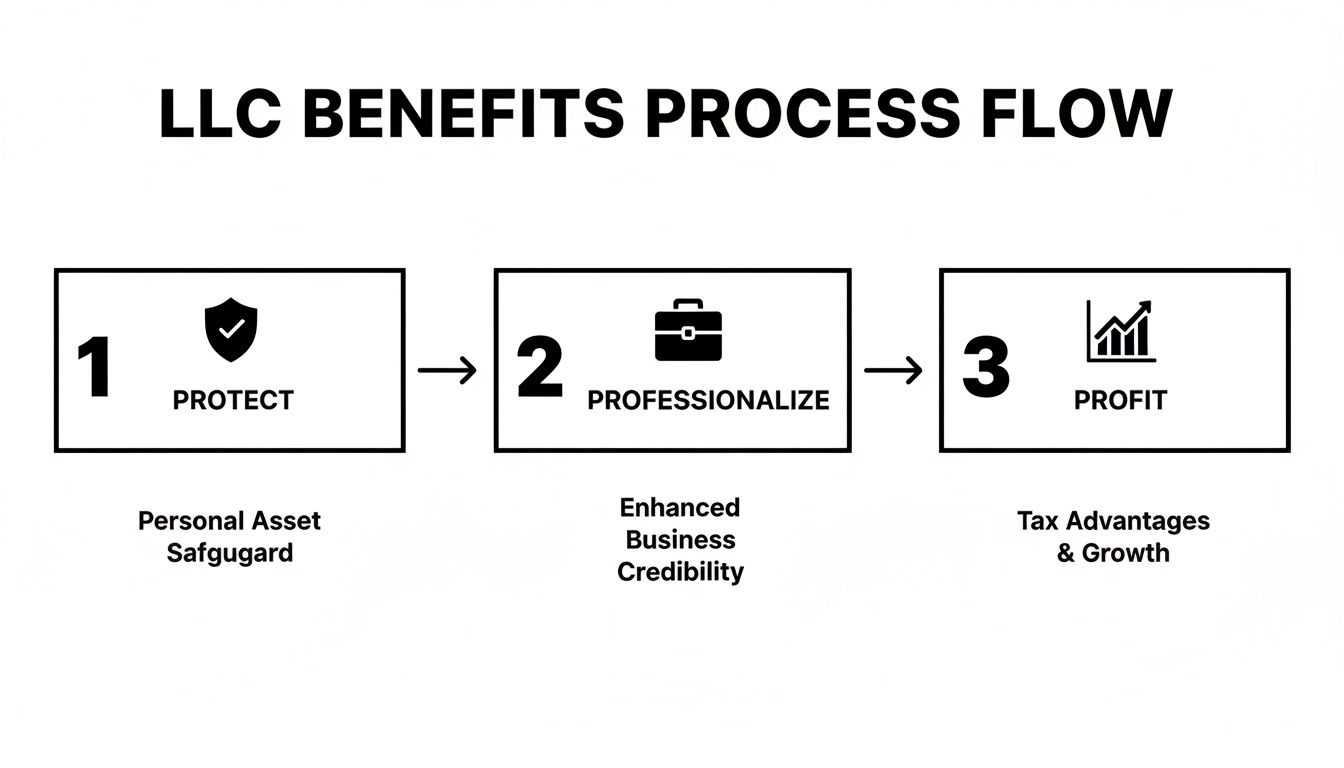
As you can see, the process isn't just about paperwork; it's about building a solid foundation for your financial future.
Finalise the Formation with a Notary
This is the big one. You'll meet with a Luxembourg notary and present them with your draft articles of association and that all-important certificate of deposit from the bank.
The notary’s job is to execute the deed of incorporation. They’ll check your documents, witness your signature on the articles, and make the creation of your company official. This is the moment your business legally comes into existence.
Luxembourg is a great place for freelancers, and this process reflects that. The whole system is remarkably efficient—it only takes five key procedures and can even be done remotely. From start to finish, you're looking at about one month. In fact, a whopping 94.7% of firms register right away, which lets them get their cash flow management sorted from day one. You can dive deeper into the efficient company setup in Luxembourg on lawyers-luxembourg.com.
Register with the Trade and Companies Register
With the notarial deed signed and sealed, the last step is registering your new llc limited liability company with the Luxembourg Trade and Companies Register (RCS). The good news is your notary usually handles this filing for you.
Once your registration is published in the official gazette, that’s it! Your SARL is officially formed and ready for business. You’ll get a registration number and can start signing contracts and sending out professional invoices to your clients.
Understanding Your Tax Obligations in Luxembourg
Once you’ve successfully formed your llc limited liability company (SARL) in Luxembourg, the next big hurdle is getting a firm grip on your tax responsibilities. The word "tax" can feel daunting, but the good news is that Luxembourg’s system is logical, well-structured, and genuinely supportive of growing businesses.
Nailing these obligations from day one is non-negotiable for staying compliant and keeping your cash flow healthy. Let's break down the main taxes you'll face into manageable pieces.
Corporate Income Tax and Surtax
The main tax on your SARL's radar is the Corporate Income Tax (CIT). This is simply a tax on your company's net profits—what’s left after you’ve paid all your legitimate business expenses. Think of it as the government's slice of your company's success for the year.
What's great for freelancers and small businesses is that Luxembourg’s CIT is progressive. Instead of a single flat rate, the percentage you pay climbs with your profits. This means if you have a slow year, you pay a lower rate, which is a massive help for preserving cash when you need it most.
On top of the CIT, there's also a solidarity surtax, which comes in at 7% of your CIT bill. It's a small extra that contributes to an employment fund.
The combination of a progressive CIT and the solidarity surtax creates a system where your tax burden grows in proportion to your success. This structure is deliberately designed to avoid placing a heavy financial strain on startups and smaller enterprises.
Municipal Business Tax
Beyond the national CIT, your SARL will also need to pay a Municipal Business Tax (MBT). As the name suggests, this is a local tax, and the rate can vary slightly depending on where in Luxembourg your business is officially based. For companies registered in Luxembourg City, the rate is 6.75%.
This tax is also calculated on your profits, though the formula has a few minor tweaks. When you add up the CIT, the solidarity surtax, and the MBT, you get your total effective corporate tax rate. For most small businesses, this combined rate is very competitive when compared to other major European business hubs.
Value Added Tax Essentials
Value Added Tax (VAT)—or TVA, as it's known locally—is a consumption tax that applies to most goods and services. If your business provides services or sells products, you’ll almost certainly need to register for VAT. Once you’re registered, you get a VAT number that has to appear on every invoice you send out.
The process itself is quite simple: you add VAT to your client invoices, and then, on a regular schedule, you pay the tax you've collected to the authorities. The clever part is that you get to subtract any VAT you paid on your own business purchases.
Luxembourg’s framework is especially kind to freelancers, with progressive rates designed to help modest earners. Starting from the 2025 tax year, businesses with a taxable income under €175,000 will enjoy a base CIT rate of just 14%. The standard VAT rate is 17%, but lower rates of 3%, 8%, and 14% apply to certain goods and services. You can get more details about Luxembourg's corporate tax rates on taxsummaries.pwc.com.
Withholding Tax and Double Tax Treaties
Lastly, you’ll want to get familiar with withholding tax. This is particularly important if you plan on paying yourself dividends from the company's profits as a shareholder. In Luxembourg, a standard 15% withholding tax is applied when dividends are paid out.
But here’s where Luxembourg really shines: it has double tax treaties with over 80 countries. These agreements are designed to stop you from being taxed on the same income twice. Depending on the treaty with your country of residence, that 15% withholding tax can often be cut down significantly, sometimes even in half. This is a huge plus for international freelancers running their llc limited liability company from Luxembourg, as it helps protect payments from international clients. For more hands-on advice, be sure to read our guide on essential freelance tax tips.
Managing Your Day-to-Day Finances as an LLC

Alright, you've done the hard work of officially forming your llc limited liability company. That’s a huge step! Now, the focus shifts from the one-time legal setup to the day-to-day rhythm of running your business. This is where the rubber meets the road, and getting a handle on your finances from the get-go is the secret to staying sane and successful.
Good financial hygiene isn't just a smart habit—it's what keeps that liability shield you just built strong and secure. Nailing this now will save you a world of headaches come tax season and keep your business humming along smoothly.
The First Rule: Separate Your Finances
Before you do anything else, open a dedicated business bank account. Seriously, this isn't just a suggestion; it's the golden rule. When you start mixing personal and business funds—a messy habit called "co-mingling"—you create a massive risk for yourself.
Think about it: if you pay for business software with your personal credit card or use your business debit card to buy groceries, you’re blurring the lines. This can lead to a legal nightmare known as "piercing the corporate veil," where a court could decide your business isn't a separate entity after all. Suddenly, your personal assets are on the line in a business lawsuit.
Opening a dedicated bank account for your LLC is the non-negotiable foundation of sound financial management. It enforces the legal separation between you and your business, preserving your limited liability protection.
Besides the legal protection, this separation makes bookkeeping a thousand times easier. Your accountant will be eternally grateful when they receive a clean record of all business income and outgoings, without having to pick your personal spending out of the mix.
Professionalising Your Invoicing and Cash Flow
With a business bank account in place, your next challenge is managing cash flow. As a freelancer, income can be unpredictable, so knowing exactly what you’re owed and when it’s coming in is vital for your stability. It all starts with sending professional invoices.
Every invoice you send should look the part. It needs to be clear, detailed, and sent out the door as soon as the work is done. Make sure it includes:
- Your official company name (including "SARL") and address.
- Your company's registration and VAT numbers.
- A unique invoice number for easy tracking.
- A clear description of the services you provided.
- The total amount due and the payment deadline.
Juggling PDFs and tracking payments in a spreadsheet might work when you have one or two clients, but it gets chaotic fast. It’s far too easy to let an overdue payment slip through the cracks, and that directly affects your ability to pay your own bills. This is where a good tool can make a world of difference.
Using Lightweight Tools to Stay Organised
You don’t need to jump straight into a complex, expensive accounting suite. For most freelancers, a lightweight invoice tracking tool is more than enough to automate these tedious but crucial tasks, keeping you organised and in full control of your income.
These platforms are built with the freelance workflow in mind. You can generate sharp-looking PDF invoices in minutes, see which payments are pending or overdue on a simple dashboard, and send polite, automated reminders with a single click. It takes the awkwardness out of chasing late payments and helps you get paid faster. Our guide offers more detail on how you can effectively track your freelance invoices to maintain a healthy cash flow.
Even better, features like cash flow predictions can give you a clearer picture of your income over the next few months, which makes financial planning a whole lot easier. By using a tool like this, you’re also automatically building an organised, accurate record of your earnings. This not only gets you ready for tax time but also ensures you have all the right documentation for your annual compliance, making your llc limited liability company far simpler to manage for both you and your accountant.
Maintaining Your LLC and Staying Compliant
Getting your LLC set up is a huge win, but it’s not a one-and-done deal. To keep that precious liability shield intact and stay on the right side of the law in Luxembourg, you have a few ongoing responsibilities. Think of it like a car's MOT – it's the regular upkeep that keeps your business running smoothly and legally.
These aren't just boxes to tick. Each of these tasks reinforces the fact that your company is a separate entity from you personally, which is the whole point of an LLC. Staying on top of them is key to protecting your assets and avoiding nasty surprises down the road.
Annual Filings and Financial Statements
Once a year, your SARL needs to prepare and file its annual accounts. This means putting together a balance sheet and a profit and loss statement that clearly shows your company’s financial position. It's the official financial story of your business for the year.
For most freelancers, these documents must be filed with the Luxembourg Trade and Companies Register (RCS). It’s a public record, so transparency is a must.
On top of that, you’ll need to file your annual corporate tax return with the tax authorities. This report breaks down your income and expenses to calculate your tax bill. Getting this in on time and with accurate numbers is absolutely vital for staying out of trouble.
Holding an Annual General Meeting
This might sound a bit over-the-top if you’re a one-person show, but even if you’re the only owner, you still need to hold an Annual General Meeting (AGM) once a year.
Why? It's a legal formality that serves a crucial purpose. The AGM is where you, acting as the shareholder, officially sign off on the annual accounts and document any big decisions. You'll need to draft proper minutes for this meeting and keep them with your company records. It’s a simple step that really strengthens the legal wall between you and your business.
If there’s one habit to build, it’s keeping meticulous business records. This means having all your invoices, contracts, bank statements, and meeting minutes organised. These documents are your evidence that the company is a legitimate, separate business.
Speaking of contracts, our guide on creating a solid freelance contract template can be a real lifesaver for keeping your client paperwork in order.
Keeping Your Information Updated
Staying compliant also means making sure your company's details are always current. You must be registered with the Register of Beneficial Owners (RBE), which declares who is really behind the company. If anything about the ownership changes, you need to report it right away.
The same goes for any other changes. If you move your registered address or tweak your business activities, you have to update your file with the Trade and Companies Register (RCS). Not doing so can lead to fines and legal headaches. It’s a small bit of admin that shows you’re running a responsible business and keeps you in good standing with the authorities here in Luxembourg.
Your Questions Answered: The Luxembourg LLC
Thinking about setting up an LLC in Luxembourg? You've probably got a few questions buzzing around. Let's tackle some of the most common ones that freelancers and consultants ask.
Can I Really Set Up a Luxembourg LLC on My Own?
You absolutely can. Luxembourg law is very friendly to solo entrepreneurs, allowing for a single-member LLC (or SARL, as it's known here). This is a game-changer for independent contractors.
It means you can get the full liability shield of a company without having to bring on business partners. You get the legal protection of a corporation while keeping the freedom and control of being a one-person show.
What's the True Cost to Get an LLC Started and Keep It Running?
Let's break it down. The biggest initial number you'll see is the €12,000 minimum share capital for a standard SARL. But here's the key: this isn't a fee you pay to someone. It's your company's money, which you deposit into its new bank account. On top of that, expect a few thousand euros for one-off notary and registration fees.
The ongoing costs are mostly for your accountant, who will handle the official financial statements and corporate tax filings each year. It’s definitely more than what you’d pay as a sole trader, but think of it as an investment in protecting your personal savings, home, and other assets from any business trouble.
Do I Still Need an Accountant if I Use Invoicing Software?
Yes, without a doubt. For a Luxembourg SARL, an accountant (expert-comptable) isn't just a good idea—it's a legal requirement. They're the only ones authorised to prepare and file your official annual accounts and corporate tax returns, making sure you stay on the right side of the law.
Using a great invoicing tool is smart; it keeps your income records clean and organised, which will make your accountant's job easier (and maybe even cheaper!). But it doesn't take the place of their crucial compliance work.
Ready to stop chasing payments and get a clear view of your cash flow? Billzy is the lightweight invoice tracker built for freelancers. Start your 14-day trial today and see how simple managing your finances can be. Get started with Billzy.
Ready to Get Paid Faster?
Create professional invoices and track payments in seconds with Billzy.
Start Free Today