Earnings: earnings before depreciation interest and tax - freelancer's guide
When you hear accountants throw around acronyms, it's easy to tune out. But EBDIT—or earnings before depreciation, interest, and tax—is one you’ll want to remember. It’s a powerful metric that cuts through the noise to show you how profitable your core business operations really are.
Think of it as the raw cash your services bring in before you account for things like your financing choices, tax obligations, or the gradual loss in value of your work equipment.
What EBDIT Reveals About Your Freelance Business

Let's use an analogy. Imagine your business is a high-performance engine. Your net profit tells you how far you've travelled after factoring in fuel consumption, wear and tear, and road taxes. EBDIT, on the other hand, measures the raw, unfiltered horsepower that engine is capable of producing. It’s a pure snapshot of your operational health.
By stripping away a few key variables, this metric helps you answer one of the most important questions for any freelancer or consultant: is my fundamental business model actually profitable? Getting a clear answer is vital, as it isolates the performance of your services from all the other financial layers.
The Components of EBDIT
To really get what earnings before depreciation, interest, and tax tells you, it's helpful to understand what it deliberately leaves out.
- Interest: This is what you pay to borrow money. EBDIT removes it because it wants to measure your profitability regardless of whether you've used loans or your own capital to fund your operations.
- Tax: Taxes are a reality of doing business, but they're a government obligation, not a direct measure of how well you run your business. Taking them out of the equation allows for a cleaner comparison.
- Depreciation: This is an accounting concept, not a real cash expense. It accounts for the value your assets (like a new laptop or professional camera) lose over time. EBDIT ignores it to focus squarely on the actual cash your business is generating.
When you set these items aside, you're left with a much clearer view of the cash flowing directly from the services you provide. This number is often a much better indicator of your day-to-day cash flow than the final figure on a traditional profit and loss statement.
EBDIT offers a transparent look at your business's ability to generate cash from its primary activities. It helps you assess operational efficiency without the noise of accounting conventions and financing structures.
At the end of the day, EBDIT isn't just some abstract financial term; it’s a genuinely practical tool. It helps you figure out if your pricing is on point, if your running costs are manageable, and if your whole freelance venture is built on a solid, sustainable foundation. This understanding is the first step toward making smarter decisions and securing the long-term financial health of your independent career.
How to Calculate Your EBDIT Step by Step
Working out your earnings before depreciation, interest and tax is a lot less intimidating than it sounds. You don't need a degree in accounting to get a solid handle on your business's real cash flow. There are two common ways to figure it out, and which one you use just depends on the numbers you have handy.
You can either start with your final profit and add things back, or start with your total sales and subtract your costs.
- Method 1 (The "Add-Back" way): EBDIT = Net Income + Interest + Taxes + Depreciation
- Method 2 (The "Top-Down" way): EBDIT = Revenue - Operating Expenses (but don't include depreciation)
For most freelancers and consultants, that second method is usually the most straightforward. It uses figures you’re already looking at all the time—the money coming in versus the money going out to keep the lights on.
A Walkthrough: The Top-Down Method
Let's run through a quick example with the top-down formula. Say you're a freelance graphic designer having a decent quarter.
Step 1: Find Your Total Revenue First, add up all the money you’ve invoiced and earned from your client work over the period. This is your top line, your total revenue.
- Project A: €5,000
- Project B: €3,500
- Project C: €6,000
- Total Revenue: €14,500
Step 2: List Your Operating Expenses Next, pull together all the cash expenses you paid to run your business. Think software subscriptions, marketing costs, or your home office expenses. The key here is to leave out depreciation—it’s an accounting entry, not actual cash leaving your bank account.
- Software (Adobe, etc.): €250
- Marketing & Ads: €400
- Home Office Costs: €750
- Total Operating Expenses: €1,400
Step 3: Calculate Your EBDIT Now for the easy part. Just subtract those operating expenses from your revenue.
€14,500 (Revenue) - €1,400 (Operating Expenses) = €13,100 (EBDIT)
That €13,100 is your earnings before depreciation, interest and tax. Think of it as the raw cash profit you made from your design skills this quarter. It’s the pot of money you have to pay yourself, settle up with the tax office, cover any loan payments, and reinvest back into growing your business.
What About the Add-Back Method?
Just to show you how it all connects, let's look at the same freelance designer using the first formula. This approach is really handy if you’ve already got a full profit and loss statement drawn up.
Let's assume your final net income (the number after all expenses are deducted) was €9,000. To get back to EBDIT, we just need to add back those specific non-cash and non-operational costs.
- Start with Net Income: €9,000
- Add Back Taxes: Let's say you paid €2,000 in tax.
- Add Back Interest: You had €500 in interest payments on a business loan.
- Add Back Depreciation: Your fancy new computer equipment depreciated by €1,600 on your books.
Here’s what that looks like:
€9,000 (Net Income) + €2,000 (Taxes) + €500 (Interest) + €1,600 (Depreciation) = €13,100 (EBDIT)
See? Both roads lead to the same destination. It really just comes down to which numbers are easier for you to grab. For a quick, on-the-fly health check of your business, the top-down method is almost always the faster, more intuitive choice for a freelancer.
EBDIT vs. EBITDA vs. EBIT: Understanding the Differences
Let's be honest, financial metrics can sound like a confusing alphabet soup. EBDIT, EBITDA, EBIT... they all seem similar, but each one tells a slightly different story about your business's financial health. Think of them as different lenses you can use to look at your profitability, with each one bringing a specific part of the picture into sharp focus.
The real difference boils down to what gets left out of the calculation. All three start by taking your earnings and removing interest and taxes. This gives you a clearer view of your operational performance, stripping away the noise from financing decisions or tax structures. Where they really diverge is how they treat non-cash expenses like depreciation and amortisation.
A Closer Look at Each Metric
So, what does each acronym actually mean for a freelancer or small business owner? Let's break it down simply.
EBIT (Earnings Before Interest and Tax): This is the most straightforward of the three. It shows your profit before you account for loan interest and taxes. However, it still includes depreciation and amortisation. Think of it as a measure of your core operational profitability while still acknowledging the cost of "wear and tear" on your assets, like your work laptop or camera equipment.
EBDIT (Earnings Before Depreciation, Interest, and Tax): As we've already covered, this metric takes EBIT and goes one step further by excluding depreciation. This makes it a fantastic stand-in for your operational cash flow. Why? Because it ignores accounting entries (like the declining value of your computer) that don't actually involve money leaving your bank account.
EBITDA (Earnings Before Interest, Tax, Depreciation, and Amortisation): This one takes it all the way by also removing amortisation. Amortisation is just like depreciation but for intangible assets (think software licences or copyrights). EBITDA is a big deal in the corporate world for business valuation because it offers a very clean way to compare profitability across different companies and industries, regardless of their asset base or financing.
This simple diagram shows how EBDIT gets right to the heart of your cash-based performance.
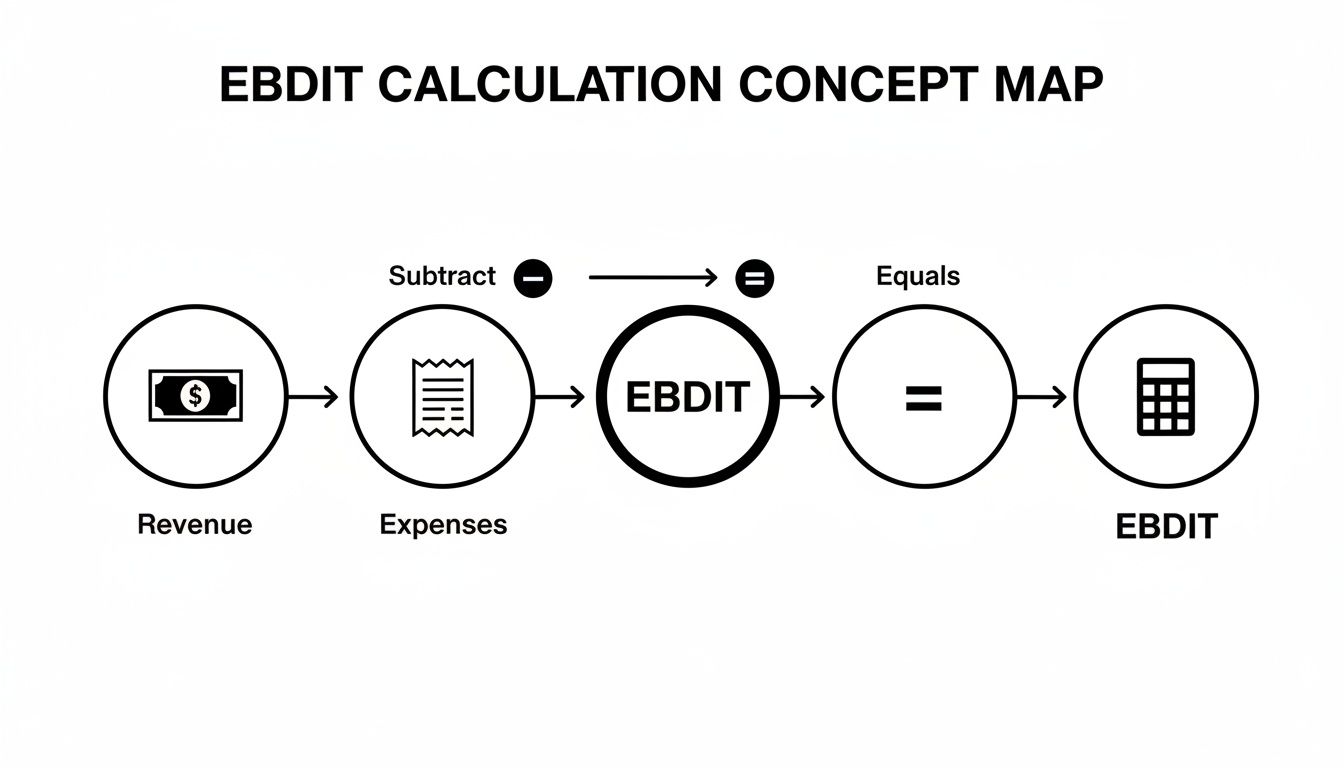
As you can see, it’s all about focusing on the actual cash your operations generate by stripping out everything else.
Comparing EBDIT, EBITDA, and EBIT
To make it even clearer, let's put these metrics side-by-side. Seeing them laid out like this can help you quickly decide which one is most useful for what you're trying to figure out.
| Metric | What It Measures | Includes Depreciation/Amortisation? | Best Use Case for a Freelancer |
|---|---|---|---|
| EBIT | Overall profitability from core business operations. | Yes | Getting a broad view of operational success, including asset costs. |
| EBDIT | Operational cash flow, ignoring physical asset depreciation. | No | Assessing your immediate ability to generate cash from your services. |
| EBITDA | A standardised measure of profitability, ignoring all non-cash expenses. | No | Comparing your performance to others or for business valuation purposes. |
Ultimately, choosing the right metric depends entirely on what you want to measure. There's no single "best" one; they're just different tools for different jobs.
Why This Matters in Luxembourg
Picking the right metric isn't just an academic exercise—it has very real consequences, especially for anyone operating in a major financial hub. For freelancers and consultants in Luxembourg, getting to grips with EBITDA is particularly important because of local tax laws.
The interest deduction limitation rule, for example, caps deductible borrowing costs at 30% of your fiscal EBITDA (or up to €3 million). This means small businesses need to keep a close eye on their EBITDA to manage their tax strategy effectively. If your interest costs go above this threshold, you may not be able to write them all off. You can learn more about Luxembourg's specific tax rules from Global Compliance News.
By understanding the nuances between EBDIT, EBITDA, and EBIT, you can choose the right tool for the job—whether that's assessing your immediate cash generation, valuing your business, or navigating complex tax regulations.
Why EBDIT Is a Vital Metric for Freelancers

So, we've covered the "what" and the "how." Now, let's get to the heart of it: why should earnings before depreciation, interest and tax actually matter to you as a freelancer?
Think of EBDIT as a direct window into your operational cash flow. It’s the metric that cuts through the noise and shows you the actual cash your business activities are generating. It answers the questions that keep freelancers up at night.
Are you bringing in enough real money to reinvest in new software or training? Can you afford to put some aside for a rainy day? And most importantly, is there enough left to pay yourself a proper salary? When you track EBDIT, it stops being just another number and becomes a powerful tool for building a truly sustainable business.
From Metric to Mindset
Getting a handle on your EBDIT helps you make smarter, more confident decisions everywhere in your business. It gives you the clarity to pinpoint and solve problems before they grow.
For instance, a healthy EBDIT is a good sign that your pricing is on point. If it’s looking a bit thin, that’s your cue to revisit your rates or hunt down hidden operational costs that are slowly eating away at your bottom line.
EBDIT isn’t just an accounting term; it’s a real-time health check on your business's ability to turn your hard work into actual cash. A strong EBDIT proves your business is resilient and running efficiently.
This kind of clarity is especially powerful in a stable economic climate. For example, the Luxembourg government's fiscal metrics show an incredibly low interest burden on public revenues—in 2023, interest payments were just 0.59459% of government revenue. For a freelancer, this stable backdrop means your personal EBDIT calculations are a more reliable gauge of your own performance, less likely to be skewed by wider economic turbulence. You can read more about Luxembourg's economic stability on Trading Economics.
A Tool for Sustainable Growth
At the end of the day, EBDIT lets you manage your business proactively instead of just reacting to whatever comes your way. It encourages you to stop chasing revenue for revenue's sake and start focusing on genuine operational profitability.
By keeping a close eye on this metric, you can:
- Validate your pricing: Get confirmation that your rates are high enough to cover all your costs and still leave you with a healthy cash surplus.
- Identify inefficiencies: Quickly spot where you might be overspending on things that don’t actually help you earn more.
- Plan for the future: Decide with confidence when it’s the right time to invest in new gear, marketing, or professional development, based on the real cash you have on hand.
By embracing earnings before depreciation, interest and tax as a core indicator of your business’s health, you gain the financial insight to build something that isn't just profitable today, but resilient for years to come.
Actionable Strategies to Improve Your EBDIT
Knowing your earnings before depreciation, interest and tax is one thing, but actually improving it is where you start building a healthier business. The good news is that boosting your EBDIT doesn't require complicated financial wizardry. It all comes down to fine-tuning your daily operations to bring in more cash.
Think of it this way: every strategy boils down to one of two simple goals—speeding up the money coming in or slowing down the money going out. Small, consistent tweaks in these areas can have a surprisingly big impact on your operational profitability.
Streamline Your Invoicing and Get Paid Faster
The fastest way to give your EBDIT a lift is to shrink the time it takes to turn your work into cash. In simple terms, the quicker you get paid, the better your cash flow looks and the stronger your business becomes.
Don't let your invoices sit around gathering dust. Getting a solid system in place to send them out the door the minute a project is finished is crucial. You also need to be professional but firm with your follow-ups as due dates get closer.
- Invoice Immediately: Get into the habit of sending an invoice the moment you deliver the final work, rather than waiting for the end of the month.
- Offer Multiple Payment Options: Make it dead simple for clients to pay you. Offer bank transfers, credit cards, or whatever online payment methods they prefer.
- Use Clear Payment Terms: Be crystal clear. State the exact due date on the invoice (e.g., "Payment due in 15 days") so there’s absolutely no room for confusion.
Optimise Your Pricing and Service Offerings
How you price your services directly affects the "earnings" side of the EBDIT calculation. One of the easiest ways to hurt this metric is by undercharging. It just means you’re working harder for less actual cash profit.
Take a hard look at your rates regularly. Do they genuinely reflect the value you bring to your clients? Do they cover all your business costs and leave you with a decent profit? Using a freelance rate calculator can be a great way to benchmark yourself against the market and see if you’re on track.
A smart pricing strategy ensures every hour you bill is actively boosting your EBDIT, not just covering your expenses. It’s the classic case of working smarter, not harder.
Cut Unnecessary Operational Costs
The final piece of the puzzle is keeping a tight rein on your expenses. Every single euro you don't spend on things you don't need goes straight to your bottom line, pumping up your EBDIT. It’s a good idea to set aside time each quarter to review your outgoings.
Hunt for those sneaky subscriptions you forgot you had, look for software that could be swapped for a more affordable option, or plug any other small leaks in your budget. This isn't about being stingy—it's about being smart and efficient with your money.
For professionals in Luxembourg, this is especially relevant. Local tax rules (ATAD1) cap corporate interest deductions at 30% of EBITDA or EUR 3 million. So, a consultant earning EUR 500,000 in EBITDA can only deduct EUR 150,000 in net interest. This makes having strong core profitability—a high EBDIT—even more vital. You can dig deeper into how these rules work with PwC's detailed tax summaries.
How Billzy Helps You Track and Boost Your EBDIT
Knowing your earnings before depreciation, interest and tax is one thing. Actually improving it is another. That's where the right tools come in, turning financial data into real, tangible progress. Billzy is built to be that tool—a financial command centre for freelancers and consultants who need to not just track EBDIT but actively push it higher.
At its core, Billzy helps you get a firm grip on the "Earnings" part of the equation. The simple, clean dashboard shows you exactly where your revenue stands at any given moment by tracking paid, pending, and overdue invoices all in one place.
You no longer have to dig through spreadsheets or cross-reference bank statements just to get a clear picture of your income. It’s all right there.
Streamline Your Accounts Receivable
For most freelancers, nothing kills cash flow—and drags down EBDIT—quite like slow-paying clients. Billzy tackles this problem head-on by acting as your own automated accounts receivable department.
By automating payment reminders and overdue alerts, you can systematically reduce the time it takes to get paid. This directly boosts your cash flow, strengthening your operational profitability without any extra effort.
This consistent, professional follow-up shrinks your payment cycles and ensures the money you've already earned lands in your bank account sooner.
Enforce Your Payment Terms Consistently
Protecting your revenue is vital for a healthy business. Billzy gives you the tools to enforce your payment terms fairly and without awkward conversations, which is a massive part of maintaining a strong EBDIT.
- Automated Late Fee Calculator: With just a click, you can apply your pre-agreed late fees to overdue invoices. This not only compensates you for the delay but also gently discourages it from happening again.
- Clear Payment Histories: See every client's payment patterns over time. This kind of insight is invaluable when it comes to negotiating future projects or deciding on payment terms.
By connecting these practical features directly to your financial metrics, Billzy becomes more than just an invoicing tool. It’s a strategic partner in improving your earnings before depreciation, interest and tax. You can explore the full toolkit by checking out all the Billzy features designed specifically for freelancers.
Got Questions About EBDIT? We’ve Got Answers.
Diving into financial metrics can feel like learning a new language. It’s natural to have a few questions. Here are some of the most common ones we hear from freelancers and consultants about earnings before depreciation, interest and tax.
What if My EBDIT Is a Negative Number?
It absolutely can be, and if it is, you should pay close attention. A negative EBDIT is a major red flag. It’s a sign that your core business operations are losing money, even before you factor in things like loan interest or taxes.
For a freelancer, this means the money coming in from your clients isn't enough to cover your direct operating costs. Think of it as an early warning system. It's telling you to take a hard look at your pricing, your project pipeline, or where your money is going. Getting this number back into the positive is key to building a sustainable business.
How Often Should I Be Calculating My EBDIT?
For most freelancers, running the numbers quarterly is a fantastic rhythm. This gives you a regular, clear snapshot of your profitability and cash flow trends without bogging you down in admin every single week.
Now, if you're in a big growth spurt or your income is all over the place month-to-month, you might want to calculate it monthly. Doing it more often gives you real-time feedback, helping you make quick adjustments to stay on course and hit your financial targets.
The Bottom Line: You won’t find EBDIT on any official financial statements, but that’s not where its value is. Its real power is as an internal tool—it gives you a clean, straightforward look at the health of your core operations.
Is EBDIT an Official Accounting Metric?
Nope, it’s not. EBDIT isn't a standardised metric under formal accounting rules like GAAP or IFRS. This makes it what’s known as a "non-GAAP" measure, which means there isn't one single, universally agreed-upon way to calculate it.
But that doesn’t make it less useful. Its purpose isn't for official tax returns or bank reports. It’s for you. By stripping away the non-cash expenses and financing structures, it helps you get a much clearer picture of how well your business is actually performing on a day-to-day basis.
Ready to stop guessing and start knowing where your business stands? Billzy gives you the tools to track every invoice, get paid on time, and truly understand your profitability. Start your free trial at Billzy.io and take control of your cash flow.
Ready to Get Paid Faster?
Create professional invoices and track payments in seconds with Billzy.
Start Free Today