How to Calculate the WACC: how to calculate the wacc for your freelance business
To get your WACC, you’re essentially blending the cost of your equity with the cost of your debt. Each is weighted based on how much of it you use to fund your business.
Think of it this way: WACC is the average rate of return you need to generate to keep all your financiers—shareholders and lenders alike—happy. It boils down to a single percentage that becomes your financial baseline, helping you make much smarter investment decisions.
What WACC Really Means for Your Business

Let's cut through the financial jargon for a moment. The Weighted Average Cost of Capital (WACC) isn't just some abstract metric reserved for massive corporations. For a freelance business or a small agency, it's a practical tool for understanding the real cost of keeping your operations funded.
Imagine it as the combined interest rate you're paying on all your financing—whether that’s a formal business loan or the personal capital you’ve ploughed into the business.
Knowing this number is crucial for making big decisions with confidence. Is that new project you’re eyeing actually going to be profitable once you factor in financing costs? Does it make financial sense to take on that new business loan right now? WACC gives you a clear benchmark to find the answers.
The Hurdle Rate Concept
One of the most powerful ways to use WACC is as a hurdle rate. This is simply the minimum rate of return a new project must deliver to be worth your time and money.
For instance, if a potential project is projected to return 8%, but your WACC is 10%, taking it on would actually lose you money in the long run. It fails to clear the hurdle.
By setting this clear threshold, WACC transforms your business decisions from educated guesses into strategic calculations. It ensures every new venture you pursue is actively building your bottom line, not just treading water.
Why It Matters for Freelancers
For an independent professional, calculating your WACC provides a structured way to look at the risk and opportunity cost tied to your own capital. The benefits are tangible:
- Valuing Your Business: It's a foundational piece in valuation methods like a Discounted Cash Flow (DCF) analysis, which helps you figure out what your business is truly worth.
- Informed Investment Decisions: It gives you a hard number to weigh against the potential returns of new software, better equipment, or a big marketing push.
- Smarter Financial Planning: Understanding your cost of capital helps you structure your finances more effectively, whether you're seeking a loan or just reinvesting your profits.
At the end of the day, learning how to calculate the WACC empowers you to think like a CFO. You start making sharper financial choices that pave the way for real, sustainable growth.
Understanding the WACC Formula

At first glance, the formula for the Weighted Average Cost of Capital can look a bit intimidating. I get it. But it's much more intuitive than it seems. The best way to think about it is as a simple recipe, blending the two main ways a business gets its money: from owners (equity) and from lenders (debt).
Here’s the standard formula:
WACC = (E/V × Re) + (D/V × Rd × (1 – Tc))
Let's break down what each of those letters actually means in the real world. Once you get a feel for the individual parts, figuring out how to calculate the WACC becomes a much clearer process.
The Equity Piece: (E/V × Re)
This first half of the equation is all about the money you and any other owners have put into the business. It’s your skin in the game.
- E (Market Value of Equity): This is the total value of all ownership in your business. If you're a freelancer, you can think of this as the net worth of your business operations.
- V (Total Market Value of Capital): This is just the sum of everything—your equity (E) plus all your debt (D). So, V = E + D.
- Re (Cost of Equity): This one is a bit more abstract but absolutely crucial. It’s the return your business needs to deliver to make your investment worthwhile, factoring in the risk you’re taking on.
The fraction (E/V) simply tells you what percentage of your company's total funding comes from its owners. If your business is valued at €100,000 and is entirely self-funded with no loans, then equity makes up 100% of your capital.
The Debt Piece: (D/V × Rd × (1 – Tc))
Now for the other side of the coin—the money you've borrowed to get things running.
- D (Market Value of Debt): This is straightforward. It’s the total amount of debt your business is carrying from sources like business loans or lines of credit.
- Rd (Cost of Debt): This is the effective interest rate you're paying on that debt. It's usually the easiest number to find; just look at your loan agreements.
- Tc (Corporate Tax Rate): This is the tax rate your business is subject to.
The really clever part of this section is the (1 – Tc) bit. This is what finance pros call the "tax shield". Since the interest you pay on business debt is usually tax-deductible, the government effectively gives you a discount. For example, if your loan has a 6% interest rate and you're in a 25% tax bracket, your real after-tax cost of that debt is just 4.5% (which is 6% × (1 - 0.25)).
At its heart, the WACC formula is a balancing act. It weighs the cost of being funded by owners (who demand a higher return for their risk) against the cost of being funded by lenders (which is cheaper, especially after tax benefits).
Understanding these components isn't just for internal planning; regulatory bodies often set benchmarks for them too. For example, the Body of European Regulators for Electronic Communications (BEREC) provides a harmonised methodology for these calculations across the EU. In 2024, BEREC set the EU-wide Equity Risk Premium—a key input for calculating the cost of equity—at 5.95%. This was a slight increase from 5.92% in 2023, reflecting the changing economic climate. If you're interested in the details, you can find the full BEREC report on WACC parameter estimation for 2024%20102%20BEREC_WACC%20parameters%20Report_2024_1.pdf.pdf) here.
Finding the Numbers for Cost of Equity and Debt
Getting the right inputs for your WACC calculation is less about abstract theory and more about being a good financial detective. Once you know where to look, finding the numbers for your cost of debt and cost of equity is actually quite manageable, even if you're running the business solo. Let's dig into how you can source each piece with confidence.
Pinpointing Your Cost of Debt (Rd)
Your Cost of Debt (Rd) is usually the most straightforward figure to nail down. It’s simply the interest rate you’re paying on the money you've borrowed for your business.
Just pull out the statements for any business loans or lines of credit you have. The stated annual interest rate on those documents is your Rd.
What if you have a few different loans? You’ll need to calculate a weighted average. Say you have a €10,000 loan at 5% interest and another €5,000 loan at 7%. Your blended interest rate becomes your true cost of debt, giving you a WACC that reflects your actual financing costs.
Demystifying the Cost of Equity (Re)
The Cost of Equity (Re) is a bit more conceptual. It’s an opportunity cost—the return you, the owner, expect to make for taking the risk of running your business instead of putting that same money into a different, safer investment.
The most common way to estimate this is with the Capital Asset Pricing Model (CAPM).
The formula looks like this: Re = Risk-Free Rate + Beta × (Market Risk Premium)
It might seem intimidating, but each part of that equation is a number you can track down from reliable public sources.
Risk-Free Rate (Rf): Think of this as the return on an investment with virtually zero risk. In Europe, a great proxy is the yield on a long-term government bond, like a 10-year German Bund. You can find this data on central bank websites or through major financial news outlets.
Beta (β): Beta is a measure of volatility. It tells you how your business’s performance is likely to move compared to the market as a whole. A beta of 1.0 means you move in lockstep with the market; above 1.0 means you're more volatile. Since your business isn't publicly traded, you can use the average "unlevered" beta for your industry (like consulting or creative services), which is available through financial data providers or university research.
Market Risk Premium (MRP): This is the extra return investors demand for taking the plunge into the stock market instead of sticking with a risk-free asset. This figure is widely published and regularly updated by financial analysts.
It's worth noting that regulatory bodies often set their own WACC parameters for certain industries, which can be a fantastic real-world benchmark. For example, Luxembourg's Institute of Regulation (ILR) set a pre-tax WACC of 7.10% for telecommunications providers back in 2016. Their calculation used specific market data, including a 1.8% inflation forecast and a gearing (debt-to-equity) ratio of 40%. You can see how regulators apply these ideas by checking out the ILR's detailed WACC analysis.
Once you've gathered these inputs, you have a solid, evidence-based estimate for your cost of equity. When you pair that with your cost of debt, you’ve got all the essential ingredients for an accurate WACC. Getting a handle on these components is also crucial for deeper financial analysis, as they tie directly into concepts like Earnings Before Depreciation, Interest, and Tax (EBDIT).
Putting It All Together: A Real-World WACC Example
Theory is one thing, but running the numbers on a real-world scenario is where it all starts to make sense. Let's walk through a complete, practical example to calculate the WACC for a typical freelance consultant based in Luxembourg. This gives you a clear blueprint you can adapt for your own business.
First, let's get a picture of our consultant's financial structure.
- Owner's Equity (E): €50,000
- Business Loan (D): €20,000
- Total Capital (V): €70,000 (€50,000 + €20,000)
From this, we can figure out the weight of both equity and debt in their capital mix.
- Weight of Equity (E/V): €50,000 / €70,000 = 71.4%
- Weight of Debt (D/V): €20,000 / €70,000 = 28.6%
So, the business is funded roughly 71% by the owner's capital and 29% by debt. Simple enough.
Sourcing the Inputs for the Formula
Now for the tricky part: finding the values for the cost of debt (Rd) and the cost of equity (Re). It's a bit of a discovery process, as you need to pull information from different places.
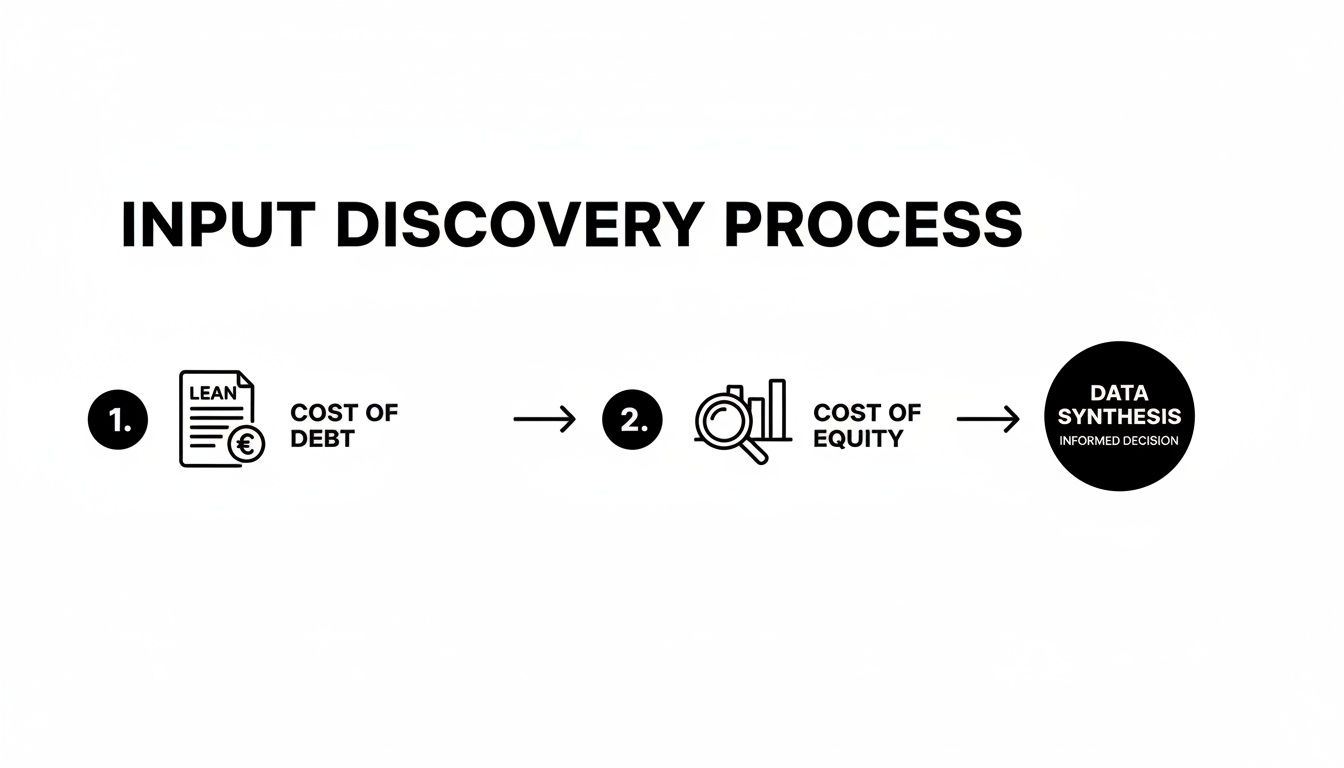
As you can see, figuring out your cost of debt is an internal job—you just need your loan documents. The cost of equity, however, requires you to look outwards at market data.
Cost of Debt (Rd)
Let's start with the easy one. Our consultant has a loan agreement that clearly states an annual interest rate of 6%. So, our Rd is 6.0%. We also need to factor in the tax shield. For this example, we'll assume a corporate tax rate in Luxembourg of 25% (so, Tc = 0.25).
Cost of Equity (Re)
This one is a bit more abstract because there's no "rate" written down anywhere. We have to estimate it using the Capital Asset Pricing Model (CAPM).
- Risk-Free Rate (Rf): We need a baseline for a "zero-risk" investment. The yield on a 10-year German government bond is a great proxy, which we'll say is currently 2.5%.
- Market Risk Premium (MRP): This is the extra return investors expect for taking on the risk of investing in the stock market over the risk-free rate. A standard assumption for the European market is around 6.0%.
- Beta (β): Beta measures how volatile your business is compared to the overall market. Since a private consulting firm isn't publicly traded, we have to estimate this by looking at similar publicly listed professional services firms. It's a relatively stable industry, so a Beta of 0.9 is a reasonable assumption.
Now we can plug these into the CAPM formula to find our cost of equity:
Re = 2.5% + 0.9 × (6.0%) = 7.9%
The Final WACC Calculation
Alright, we've gathered all the pieces. Let’s bring them together in the WACC formula.
The table below provides a clear, step-by-step breakdown of how we get from our raw inputs to the final WACC number.
WACC Calculation Walkthrough for a Freelance Consultant
| Variable | Value/Source | Calculation Step |
|---|---|---|
| Weight of Equity (E/V) | 71.4% | Calculated from business capital structure. |
| Cost of Equity (Re) | 7.9% | Estimated using the CAPM formula. |
| Weight of Debt (D/V) | 28.6% | Calculated from business capital structure. |
| Cost of Debt (Rd) | 6.0% | From the consultant's business loan agreement. |
| Tax Rate (Tc) | 25% | Assumed Luxembourg corporate tax rate. |
| Equity Component | 5.64% | (E/V × Re) or (0.714 × 7.9%) |
| Debt Component | 1.29% | (D/V × Rd × (1 – Tc)) or (0.286 × 6.0% × 0.75) |
| Final WACC | 6.93% | Equity Component + Debt Component |
This walkthrough clearly separates the equity and debt portions before combining them, making it easy to see how each part contributes to the final blended cost.
Let's do the final addition:
WACC = 5.64% + 1.29% = 6.93%
So, for our freelance consultant, the Weighted Average Cost of Capital is 6.93%. This number is incredibly powerful. It represents the minimum return that any new project, investment, or even the business itself must generate to be considered value-adding.
Getting a handle on your WACC is a cornerstone of smart financial management. It's especially critical for more advanced valuation techniques. For a deeper dive into how this metric powers business valuation, check out our guide on the discounted cash flow model—a method that simply doesn't work without an accurate WACC.
Making Sense of Your WACC (and Avoiding Common Pitfalls)
Getting to a final number for your Weighted Average Cost of Capital is a great first step, but it’s what you do with that number that really matters. Think of it less as a final score and more as a financial compass. It tells you your current position, but you still need to know how to read the map to get where you're going.
So, what does that percentage actually tell you about your freelance business?
In simple terms, your WACC is the minimum return you need to earn on your existing assets just to keep your lenders and yourself (the owner) happy. A high WACC, say over 10-12%, often points to higher perceived risk, which means it’s more expensive for you to raise funds. On the flip side, a lower WACC suggests you can finance new projects and chase growth more cheaply.
Your WACC Is Your Project Hurdle Rate
The most practical, day-to-day use for your WACC is as a hurdle rate for any new investment or project you're considering. It's the absolute rock-bottom return a new venture must generate to be worth your time and money.
Let’s say you’re thinking about a project that’s projected to deliver a 7% return. If your WACC is 6.93% (like in our earlier example), that project just scrapes over the bar. It adds a tiny bit of value, but not much. But what if that same project only promised a 5% return? It wouldn't even clear the hurdle. Taking it on would actually erode the value of your business over the long run.
This simple benchmark transforms decision-making from a gut feeling into a data-backed process. It provides a clear 'yes' or 'no' answer to whether an opportunity is truly profitable after accounting for all your financing costs.
Common Traps to Sidestep
Knowing how to run the WACC calculation is only half the battle. I’ve seen countless freelancers and small business owners do all the hard work, only to trip up on a few common mistakes that make their final number pretty much useless.
Here are the most frequent errors I see people make:
- Using Book Value Instead of Market Value: This is hands-down the biggest mistake. The book value of your business (what’s on the balance sheet) is a look backwards. For WACC to be relevant, you have to use the market value of your equity and debt—what they’re worth in the real world, today.
- Forgetting All Your Debt: It’s easy to remember your main business loan, but what about other obligations? Don’t forget to include lines of credit, financing from suppliers, or any other form of debt that has an interest cost attached. It all counts.
- Grabbing the Wrong Industry Data: When you’re looking for a beta for your Cost of Equity, don’t just pick the first one you see. Make sure it's from your specific niche (e.g., ‘graphic design for tech’ is better than just ‘creative services’). And be sure it's an "unlevered" beta if your own debt levels are different from the industry average you're looking at.
Steering clear of these issues will help ensure your WACC is a genuinely powerful tool, not just an academic exercise. A solid calculation also gives you a stronger foundation for setting your prices. If you're curious how your own pricing supports your financial targets, try plugging some numbers into our freelance rate calculator. It can help connect the dots between your rates and your true cost of capital.
Common WACC Questions Answered
Once you get the hang of the calculation itself, the real-world questions start popping up. It's one thing to have the formula down, but it's another to know how to use the number with confidence. Let's dig into some of the most frequent questions I hear from freelancers and small business owners.
How Often Should I Recalculate WACC?
Don't worry, you don't need to do this every month. The best practice is to revisit your WACC calculation whenever something significant changes in your business's financial structure or the market.
Think of it as a financial health check-up prompted by specific events:
- You take on a major new loan. This directly shifts your debt-to-equity ratio, a core component of the formula.
- Interest rates move dramatically. A big swing in market rates will change your cost of debt.
- Your business fundamentally changes. Pivoting your services or entering a new market could alter your risk profile, which affects your Beta.
For most independent professionals, giving it an annual review when you're doing your other financial planning is more than enough to keep the number relevant.
What If I Have No Business Debt?
Perfectly fine! In fact, this is a very common situation for freelancers who have bootstrapped their business. If you're running on your own capital with no loans, the calculation gets much simpler.
When you have zero debt (D=0), the entire debt portion of the WACC formula just drops away. Your WACC simply becomes your cost of equity (WACC = Re). It’s a straightforward measure of the return required to justify the risk of your business.
With no debt, your WACC is a pure reflection of the opportunity cost of having your capital tied up in your own business instead of somewhere else. Every project you take on needs to beat that number.
So, What's a Good WACC?
Ah, the million-euro question. The honest answer is, "it depends." There's no magic number for a "good" WACC. It's completely relative to your industry, your specific business risk, and the broader economic climate.
For context, a high-growth, high-risk tech startup might be looking at a WACC of over 15%. On the other hand, a stable, predictable utility company could have a WACC closer to 5%.
Your goal isn't to chase some arbitrarily low number. It's to understand what your WACC is telling you. The real objective is to make sure your project returns consistently and comfortably exceed your unique WACC, whatever that figure happens to be.
Where Can I Find Good Data for the Calculation?
Finding reliable data for inputs like the risk-free rate, Beta, and the market risk premium is actually pretty accessible. You don't need a Bloomberg terminal on your desk.
- Risk-Free Rate: A great proxy for this is the current yield on long-term government bonds from a stable economy. Think German 10-year Bunds. You can usually find this on the websites of central banks or major financial news outlets.
- Beta & Market Risk Premium: You can often get this information for free from academic sources. For instance, NYU's Stern School of Business publishes fantastic, regularly updated datasets on industry Betas and country risk premiums that are widely used and respected.
Stop chasing invoices and start getting paid. Billzy gives you a crystal-clear view of your cash flow, with automated reminders and simple tracking that frees you from spreadsheet chaos. Start your 14-day trial for just $3.
Ready to Get Paid Faster?
Create professional invoices and track payments in seconds with Billzy.
Start Free Today